Last updated: November 8, 2026
Published November 8, 2026 · Updated November 8, 2026
 Listen to this articleAudio version
Cold email for tax practices in North York works best when it is timed to each prospect’s corporate fiscal year-end, because the CRA requires a T2 corporate return within six months of that year-end, and year-ends fall in every month of the calendar. This piece compares three outreach calendars: a personal tax season push (January to April), corporate year-end-timed outreach, and an always-on flat cadence. For a practice that wants corporate clients, the year-end calendar wins. For a practice built mainly on personal T1 returns, the answer changes, and the sections below explain why.
- The CRA T2 filing deadline is six months after a corporation’s fiscal year-end, so a corporation with a December 31 year-end files by June 30.
- Personal tax season outreach collides with the T1 deadline of April 30, the weeks when a tax practice has the least capacity to take on new work.
- Corporate fiscal year-ends are not printed in most lead databases such as Apollo.io, so the first cold email should ask about timing and the answer should be saved in HubSpot or Salesforce.
- Follow-up timing of four to seven days between touches is a sound rule for B2B cold email to business owners.
- CASL applies to commercial email sent to Canadian business addresses, so every campaign needs a consent basis, sender identification and a working unsubscribe; confirm the details with the CRTC or your own counsel.
How Cold Email for Tax Practices in North York Compares Across Three Calendars
Cold email calendars for tax practices differ mainly in which deadline they lean on. The personal tax season push leans on April 30. Corporate year-end outreach leans on a moving target: the six-month T2 window after each prospect’s own fiscal year-end.
If you’re a partner at a small tax practice near Yonge and Sheppard whose staff spend February to April on T1 returns and then go quiet by June, this comparison is written for you. It is not for a firm that already has a full corporate book and simply wants more personal filers.
| Attribute | Personal tax season push | Corporate year-end-timed | Always-on flat cadence |
|---|---|---|---|
| Anchor deadline | T1 due April 30 (June 15 for self-employed) | T2 due six months after each fiscal year-end | None |
| Sending window | January to April | Rolling, all 12 months | All 12 months, same volume |
| Fit with your staff capacity | Poor: meetings land at peak workload | Good: meetings spread across quiet months | Neutral |
| Typical buyer reached | Owner-operators wanting a personal return done | Incorporated owners, controllers, small CFOs | Mixed |
| Data work required | Low: one list, one message | High: year-end field in HubSpot or Salesforce | Medium |
| Engagement value per client | One return per year | T2, financial statements, often bookkeeping and payroll | Depends on list |
| Best-fit practice | T1-heavy practices | Practices building a corporate book | Practices testing the channel |
One row matters more than the rest. Capacity decides whether a booked meeting turns into a well-run engagement. A meeting booked in the second week of April is a meeting your best senior may have to rush.
Option 1: The Personal Tax Season Push
The personal tax season push sends cold email from January through April, riding the attention that the April 30 T1 deadline creates. It is the default because it is easy. Everybody already thinks about taxes in March.
Strengths: the message needs little explanation, the list is simple to build in Apollo.io, and a reply often turns into a signed engagement letter quickly. For self-employed owners, the June 15 filing date extends the window slightly.
Weaknesses: every tax practice in Toronto is competing for the same inboxes in the same weeks, so the email reads like the ninth one that day. Worse, the replies arrive when your team has no spare hours. A prospect who waits three days for a callback in late March has usually found someone else.
There is also a value problem. A personal return is one engagement per year. A cold email program aimed at business-to-business buyers earns more when it reaches owners whose corporation needs a T2, year-end statements and ongoing bookkeeping.
Short version: the personal push fills a calendar you cannot service well, with engagements that are smaller than they could be.
Option 2: Corporate Year-End-Timed Outreach
Corporate year-end-timed outreach schedules each prospect’s emails around that company’s fiscal year-end, so the conversation happens while the owner is starting to think about statements and the T2. Canadian corporations can choose a fiscal year-end other than December 31, which is why this calendar spreads across all twelve months.
The CRA sets two clocks after a year-end. The T2 return is due within six months. The balance of tax owing is generally due two months after year-end, or three months for some Canadian-controlled private corporations that meet the conditions. Both clocks give your email a reason to arrive at a specific moment rather than at random.
The data problem nobody mentions
Fiscal year-ends are not a standard field in Apollo.io, Clay or most B2B databases, because private corporations do not publish them. That changes how the first email should be written. Instead of guessing, the opening message asks one easy question: when does your year close?
Every reply, even a not-right-now, becomes useful data. The answer goes into a custom field in HubSpot or Salesforce, and the next sequence is scheduled to start a set number of weeks before that date. Reply management is what makes this calendar work, not the send volume.
Segment the list by industry
Build separate lists in Clay or Apollo.io for construction, dental and medical practices, restaurants and real estate holding companies, since each writes about different pain points.
Ask for the year-end in email one
A short question earns more replies than a pitch, and the answer sets the schedule for everything that follows.
Log it in the CRM
Store the year-end in a HubSpot or Salesforce property so nobody has to remember it.
Trigger a timed sequence
Start a Smartlead, Instantly.ai or Lemlist sequence ahead of the year-end, spacing follow-ups four to seven days apart.
Weaknesses: this calendar needs more setup, a disciplined CRM and someone to read and route every reply. Results also arrive more slowly, since many prospects will not be in the right window on the day you first write. For context on ramp-up, see how long cold email takes to produce sales meetings.
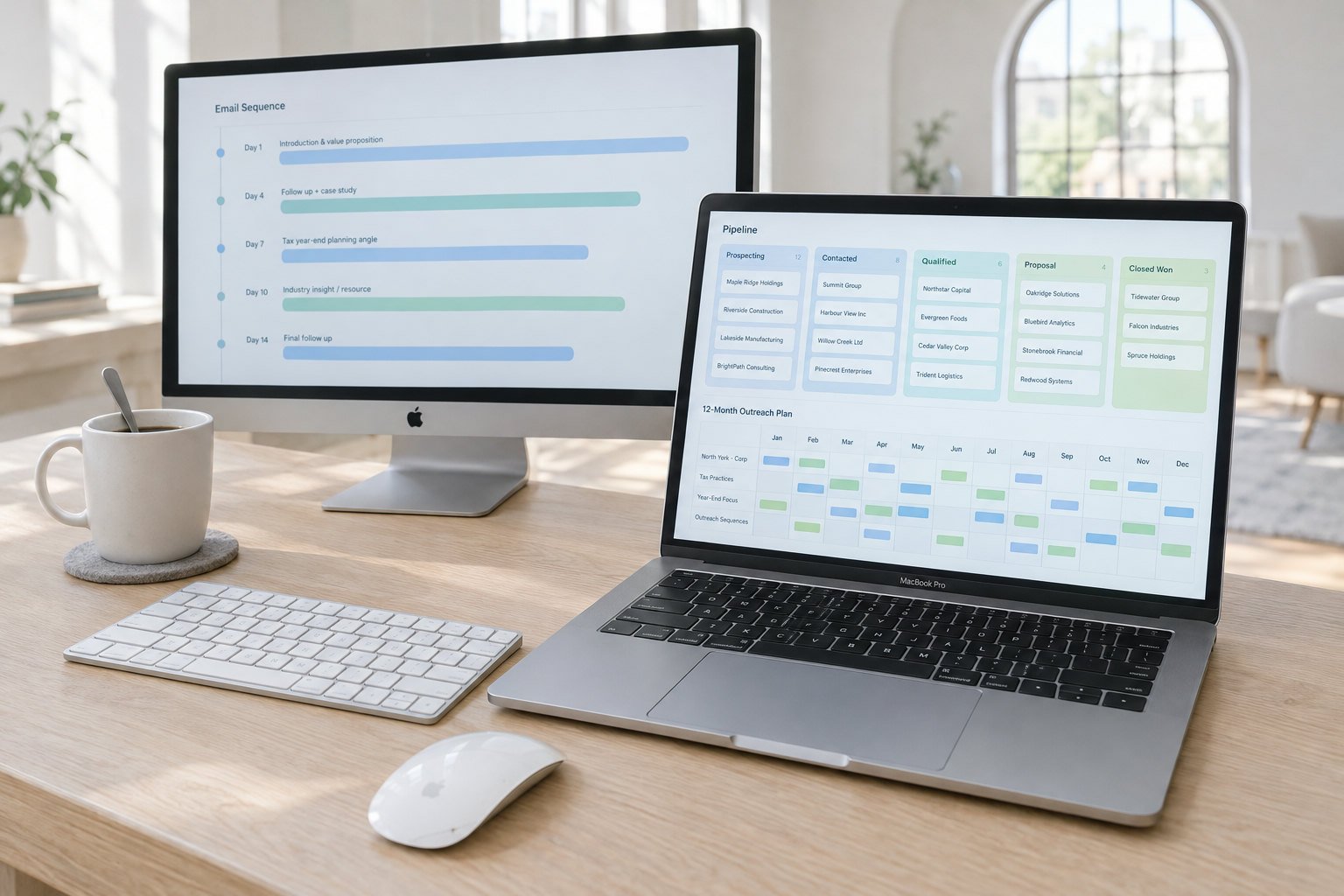
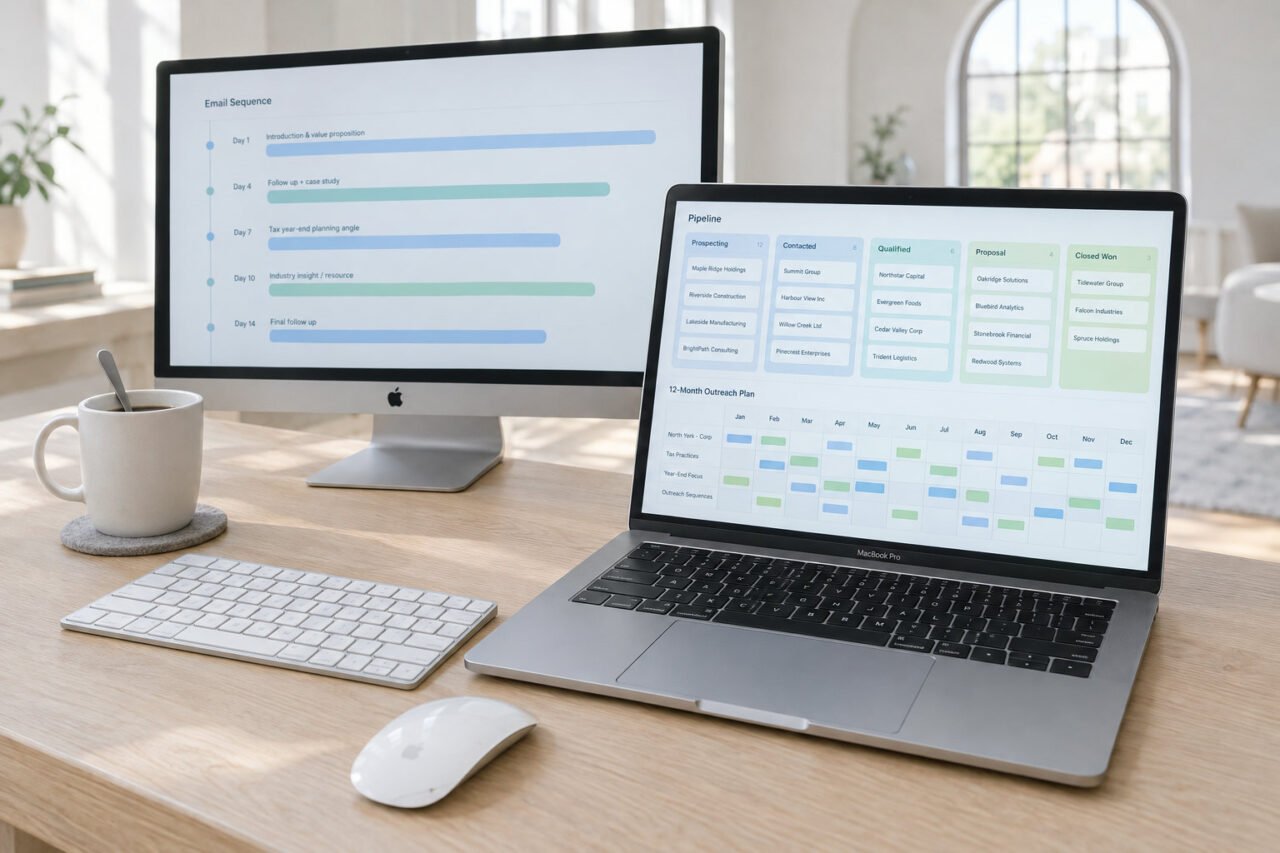
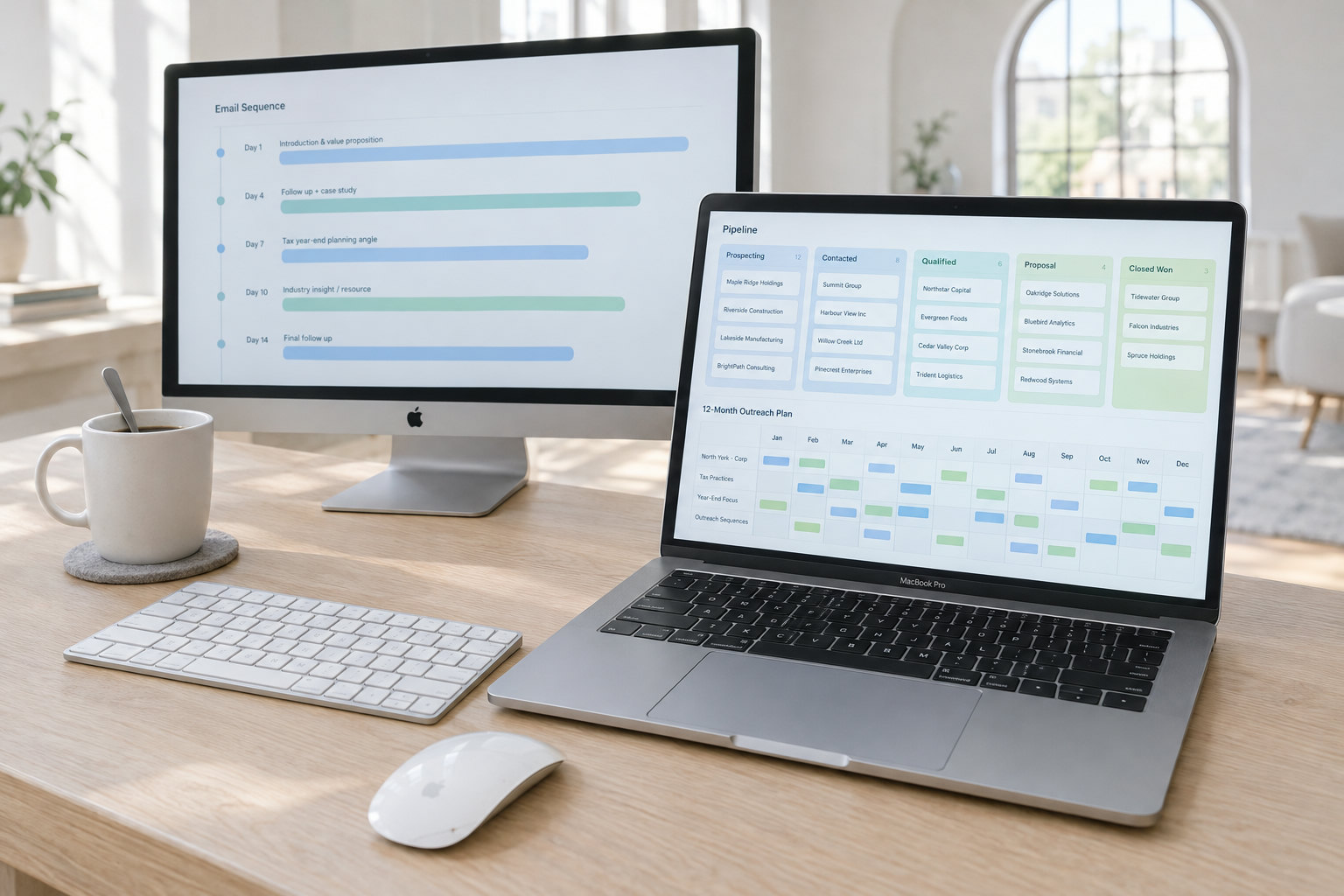
Corporate year-end outreach times each email to the six-month T2 window after a prospect’s own fiscal year-end. The year-end is rarely in lead databases, so the first email asks for it and the CRM schedules the rest.
Option 3: The Always-On Flat Cadence
The always-on flat cadence sends a steady number of cold emails every week of the year, with the same message regardless of deadlines. It is what most generic lead-generation setups default to.
Strengths: it keeps sending infrastructure warm, it gives Instantly.ai or Smartlead a stable sending pattern, and it produces a steady stream of data for A/B testing subject lines and offers. It is a sensible way to learn whether cold email suits your practice at all.
Weaknesses: the message ignores the one thing tax buyers care about, which is the date. An email offering year-end statements sent to an owner who closed their books last month is easy to ignore. A common mistake is sending one generic email to an entire list instead of segmenting by industry, company size or pain point, and the flat cadence makes that mistake tempting.
The flat cadence also does nothing to protect your capacity. It keeps booking meetings into April. Treat it as a testing phase, not a permanent plan.
- Choose the personal tax season push if most of your revenue is T1 returns, you have seasonal staff to absorb new clients in March, and you want quick, simple engagements.
- Choose corporate year-end-timed outreach if you want incorporated clients who need T2 returns, financial statements and bookkeeping, and you would rather book meetings in June through December than in April.
- Choose the always-on flat cadence if you have never run cold email before and need a few months of data on subject lines and industries before committing to a timed calendar.
- Combine two if you run a mixed practice: year-end outreach to corporations all year, paused or slowed from February to April.
Our Verdict
For a tax practice that wants to grow its corporate book, corporate year-end-timed outreach is the stronger calendar. It reaches buyers when the T2 deadline gives them a reason to talk, it spreads meetings into your quieter months, and each new client tends to bring more than one recurring engagement.
The personal tax season push still wins for one profile: the T1-focused practice with seasonal capacity. If that is you, keep it short, start in early January and stop sending well before April so you can answer replies quickly.
The always-on cadence wins only as a starting experiment. Run it for a quarter, learn which industries reply, then move to a timed calendar. If you want the first emails to sound like your partners rather than a template, this guide on scripts that sound like your team is a useful next read.
Where Best Leads fits
Best Leads builds and manages the pieces a timed calendar needs: lead lists and data enrichment, email scripts and A/B testing, sending infrastructure, and response management that books interested prospects on your calendar. The team works with HubSpot, Salesforce and Apollo, prices are agreed upfront monthly, and there are no hidden charges or cancellation fees. The full process is laid out on the how it works page.
Our view
This is opinion, plainly labeled. Tax practice owners tend to overweight send volume and subject lines when planning cold email. Those matter, but the date an email lands and the speed of the reply matter more for a deadline-driven service.
The weak point in most programs is the inbox. A reply that sits in a partner’s general inbox for a day loses momentum, and leads cool quickly. Routing replies to one person whose job is to answer and book is worth more than any copy tweak.
Compliance is the other underweighted piece. CASL applies to commercial electronic messages, CPA Ontario has rules on how members advertise, and both should be checked before launch. Treat this as general information and confirm the specifics with CPA Ontario, the CRTC or your own counsel.
- B2B Cold Email Outreach for an East York Managed IT Provider With No Outbound History — 14 Sales Meetings Booked in 45 Days Using Smartlead
- Cold Email Best Practices in Toronto for Immigration Firms: When Is an Employer Job Posting a Relevant Outreach Signal?
- A North York B2B Agency Owner Asked: ‘Can You Actually Write Cold Email Scripts That Sound Like They Come From Our Team, Not a Template?’ — Answered
- Managed Cold Email Outreach Pricing in 2026: What You’re Actually Paying for Month to Month
- Which Cold Email Outreach Tools Are Toronto Agencies Paying for Twice? Where Apollo.io, Clay, Smartlead and Instantly.ai Overlap
Frequently Asked Questions
How far before a corporate year-end should a tax practice send cold email?
Cold email to a corporation works well when it starts a few weeks before the fiscal year-end and continues into the months after, since the CRA allows six months after year-end to file the T2. Spacing follow-ups four to seven days apart keeps the sequence present without crowding the owner.
Can lead databases tell me a company’s fiscal year-end?
Lead databases such as Apollo.io and Clay generally do not hold fiscal year-ends for private corporations, because that information is not published. The practical fix is to ask in the first email and record the answer in a HubSpot or Salesforce field that triggers the next sequence.
Should a tax practice stop cold email during personal tax season?
Cold email for tax practices does not need to stop between February and April 30, but most practices are better off slowing it so replies can be answered within a day. Sequences aimed at corporations with later year-ends can keep running at lower volume.
Does CASL allow cold email to business owners in Toronto?
CASL governs commercial email to Canadian addresses and generally requires a consent basis, sender identification and an unsubscribe option in every message. Some business-to-business situations may qualify for implied consent, but this is general information only, so confirm your approach with the CRTC, CPA Ontario or your own counsel before sending.
Sources
- T2 filing deadline of six months after fiscal year-end – Canada Revenue Agency: When to file your corporation income tax return
- Personal T1 deadlines of April 30 and June 15 for self-employed individuals – Canada Revenue Agency: Important dates for individuals
- Canada’s Anti-Spam Legislation requirements – CRTC: Canada’s Anti-Spam Legislation
- Professional advertising rules for Ontario CPAs – CPA Ontario
Best Leads
Our Primary Offerings: Reliable Lead Generation Email Marketing Services.
Plan a Year-End-Timed Cold Email Calendar for Your Tax Practice →